Is AI making us dumber, or just smart in a different way?
In an age where ChatGPT tells us what to eat, Sora produces the media we consume, and AI can write a term paper before we’ve even finished our coffee, it’s fair to wonder: is AI making us dumber? Or are we like digital ouroboros, constantly consuming and regenerating our own intelligence? As artificial intelligence becomes more and more common throughout daily society, the question regarding its effect on our intelligence is increasingly relevant as a social and educational debate.

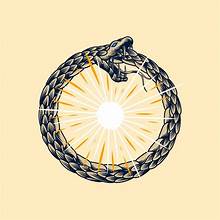
A visual representation of the ouroboros, an ancient Greek symbolic snake which may represent both regeneration or self consumption
AI as the Owl on our Shoulder
The anxiety surrounding the question on AI and its effect on our intelligence often stems from the fear that AI may cause cognitive atrophy (when we lose neurons and neural connections) because if machines begin to think for us what reason is there for us not to forget to think for ourselves. Christopher Dede, a senior research fellow at Harvard’s graduate school of education explains this controversy using mythology. Like Athena, the Greek goddess of wisdom, people today can have an “owl” on their shoulder, the only difference is today’s owl thinks in binary.
“Athena, the Greek goddess of wisdom, is always portrayed with an owl on her shoulder. We now should ask, “Can AI be like the owl that helps us be wiser?”
I think the key to having the owl be a positive force instead of a negative one is not to let it do your thinking for you… GenAI is very good at absorbing large amounts of data and making calculative predictions in ways that can augment your thinking…If AI is doing your thinking for you… that is undercutting your critical thinking and your creativity. You always have to remember that the owl sits on your shoulder and not the other way around.” –Christopher Dede
Here Dede clearly displays his point: AI can be used as a tool to enhance intelligence or it can be a crutch which breeds laziness. When used as a shortcut, AI can easily weaken the skills that make us independent thinkers. In the end, creativity, emotional reasoning are all human skills and no algorithm or AI can replicate them.

Image showing how Athena is representative as an owl on your shoulder
When AI makes us smarter: The AlphaFold program
Despite AI’s possible intelligence dulling effects, it would be oversimplistic, wrong and just plain lazy to say that’s all it does; it would be like using AI to say that AI makes us dumber! In many cases, AI can actually propel human intelligence forward, opening the possibility of solving problems that seemed impossible to solve. A great example of AI’s enhancement skills is found in biochemistry. In 2024 the nobel prize in chemistry was awarded to the creator of AlphaFold, an AI algorithm capable of accurately predicting the structure of different proteins.
In biology, structure almost always equals functions, so knowing the structure of a protein is crucial to understanding its function. For decades, mapping a protein structure was extremely tedious, it could take days to weeks to years to map a protein; the process worked similarly to how we can create salt crystals, and this would take countless trial and error. AlphaFold shortened this to mere hours; it was not making scientists dumber, it was giving them extra time to more intentional research. This example perfectly shows how AI can be used intentionally in order to expand human intelligence; when we use AI as an aid and not a base our thinking becomes sharper, not softer.

Image: Google DeepMind/Isomorphic LabsView 3 Images
The Choice Inside the Ouroboros
Just like the ouroboros, the question of whether AI is making us dumber or smarter constantly loops back on itself. AI can hollow out our thinking if we allow it to do every task for us–consuming our minds–or it can amplify our intelligence when we use it right–regenerating us. What matters is not the technology itself but the way we use it. Do we treat AI as a substitute for thought or as a tool to better understand the world? As scientists who use AlphaFold show, when we use AI as a tool to augment thinking we regenerate our intelligence instead of consuming it. The ouroboros is a circle, but the direction which we move within that circle is ours to choose.
Works Cited
The Nobel Prize. “The Nobel Prize in Chemistry 2024.” NobelPrize.org, 9 Oct. 2024, www.nobelprize.org/prizes/chemistry/2024/press-release/.
Mineo, Liz. “Is AI Dulling Our Minds?” Harvard Gazette, 13 Nov. 2025, news.harvard.edu/gazette/story/2025/11/is-ai-dulling-our-minds/.
Leave a Reply