Should apps be cancelled for turning their app fully AI automated?
Duolingo is one of the most recognized language learning apps in the world, but its rise to fame did not happen overnight. The platform was created in 2011 and fully launched for the public in 2012, June 19th, it wasn’t until the pandemic epidemic hit In 2020 that Duolingo would finally reach its peak. With millions of consumers stuck in their homes, the platforms accessibility and fun features allowed users to continue their academic journey even in their household. Suddenly, learning languages had never been easier.
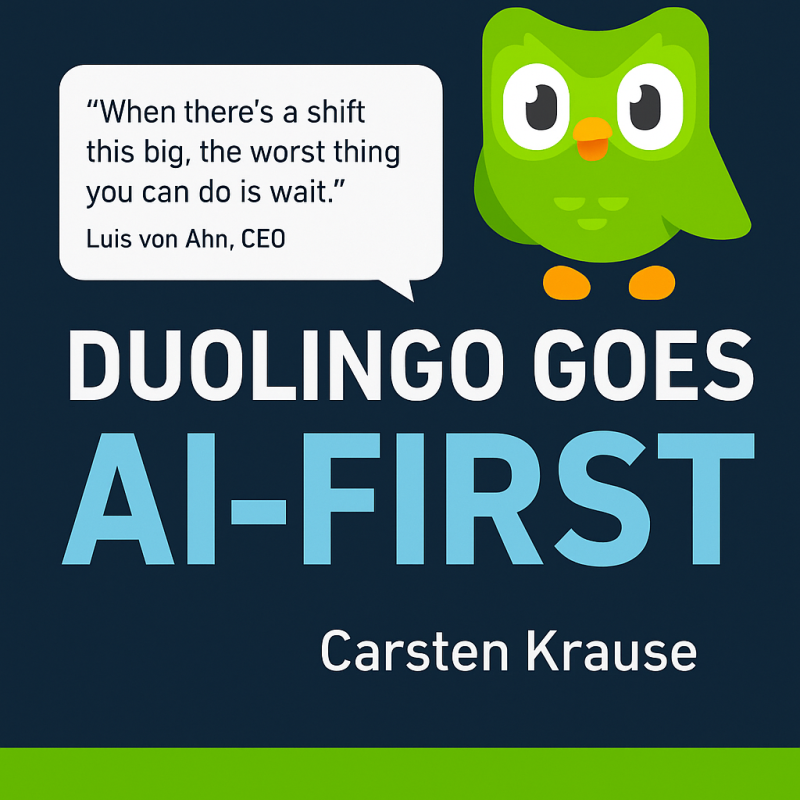
Behind this significant rise in success was Duolingo’s CEO Luis von Ahn which is also one of the apps co-founders. He had envisioned Duolingo as a free, accessible tool that would make language learning available for everyone. However, everything took a turn in April 2025 when von Ahn announced the company’s plans in becoming an “AI first” platform. Although AI had already been a part of Duolingo’s language development creation, this new goal was to push a fully AI automated platform. Consequently, many contract workers who had contributed immensely in Duolingo’s success, were then laid off and replaced with AI generated computerized material.
The CEO had claimed “Without AI, it would take us decades to scale our content to more learners,” von Ahn wrote at the time. “We owe it to our learners to get them this content ASAP.”

Ishaanvi Thakur stated in his article that “the integration of artificial intelligence with traditional automation technologies has enabled the creation of intelligent automation systems that can learn, adapt, and make decisions autonomously” (7). However, Social media platforms especially Reddit began heavily criticizing the company by stating that after this shift, the platform’s quality of the lessons declined significanttly. Some even described the lessons as “Awkward”, “inaccurate” and even lacking cultural variety. Moreover, others on the other hand has expressed their disappointment in Duolingo with their decision in removing hard working employees, making them feel like the app was losing its authenticity and reliability. The connection between the users and the app was beginning to fade, and Duolingo’s brand image started to crumble. Some long-time users had even ultimately decided to delete their app, as it didn’t feel genuine anymore.

What happened to Duolingo after this?
Despite the app becoming a victim of cancel culture, their financial impact showcased a different story. After the backlash Duolingo’s stock value had actually increased by 30%. Therefore, even though many users from the community had claimed Duolingo was now “cancelled”, the company’s eventual success seemed to say otherwise.
Overall, this modern trend of continuously cancelling people or institutions for actions that don’t align with our own beliefs seems quite harsh. Although the users concern rose from an ethical and moral standpoint, this new negative culture causes consumers to constantly feel conflicted on where they should stand in a situation, and whether their own personal opinion would be allowed. However, through all of this, is cancel culture effective? Or is it just a scheme that temporarily shuns others from our society, considering with this case of Duolino, the app’s success has never thrived more than now. So, the question I want to leave you viewers is, should cancel culture still be a part of our society? Or should be find different ways to express our opinions when it comes to an issue?
Works Cited:
Thakur, Ishaanvi. “Automation 2.0: The Impact of Artificial Intelligence.” International Journal of Research in Computer Applications and Information Technology (IJRCAIT), vol. 7, no. 2, 2024, pp. 17–23
Economic Times. “Duolingo CEO Sparks Outrage with ‘AI‑First’ Shift: Is the Owl Phasing Out People Power for Automation?” The Economic Times, 30 Apr. 2025.
Leave a Reply